Transporting Cats and Birds in the Car: A Practical Guide to Safe Travel
Animal welfareCats and birds have different needs during car travel. Here’s how to choose the right carrier, reduce noise and temperature changes, plan stops, and know when to ask a veterinarian for advice.
In this guide
Before You Leave: Two Species, Different Needs
Transporting a cat or a bird in the car is not just a matter of placing a container on the seat. Safety, stability, ventilation, and stress management should be considered based on the species and the individual animal. In Italy, the Highway Code requires that animals must not obstruct or endanger driving; if there is more than one, they must be kept in a suitable cage or container, or separated from the driver by a net or similar appropriate barrier S1.
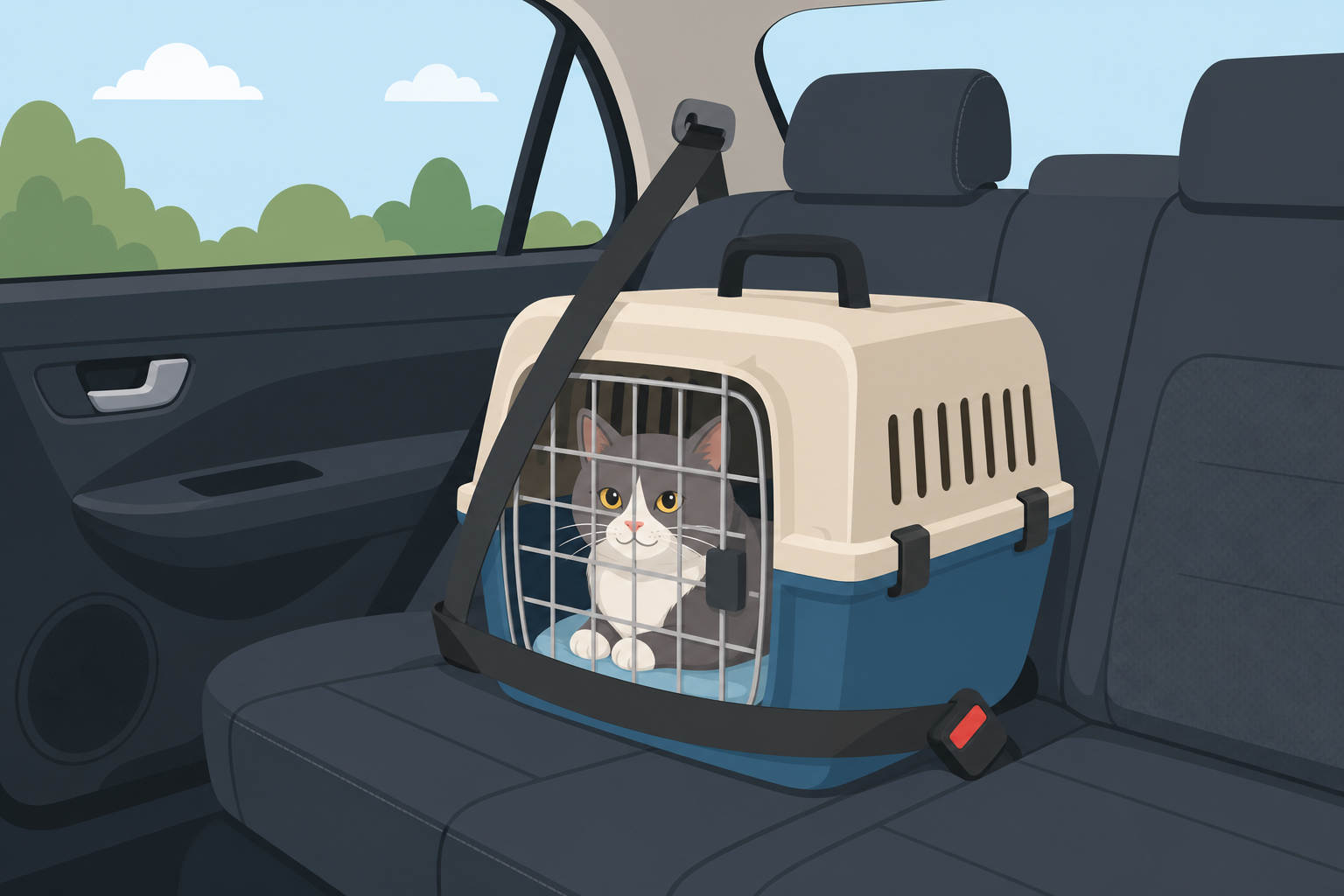
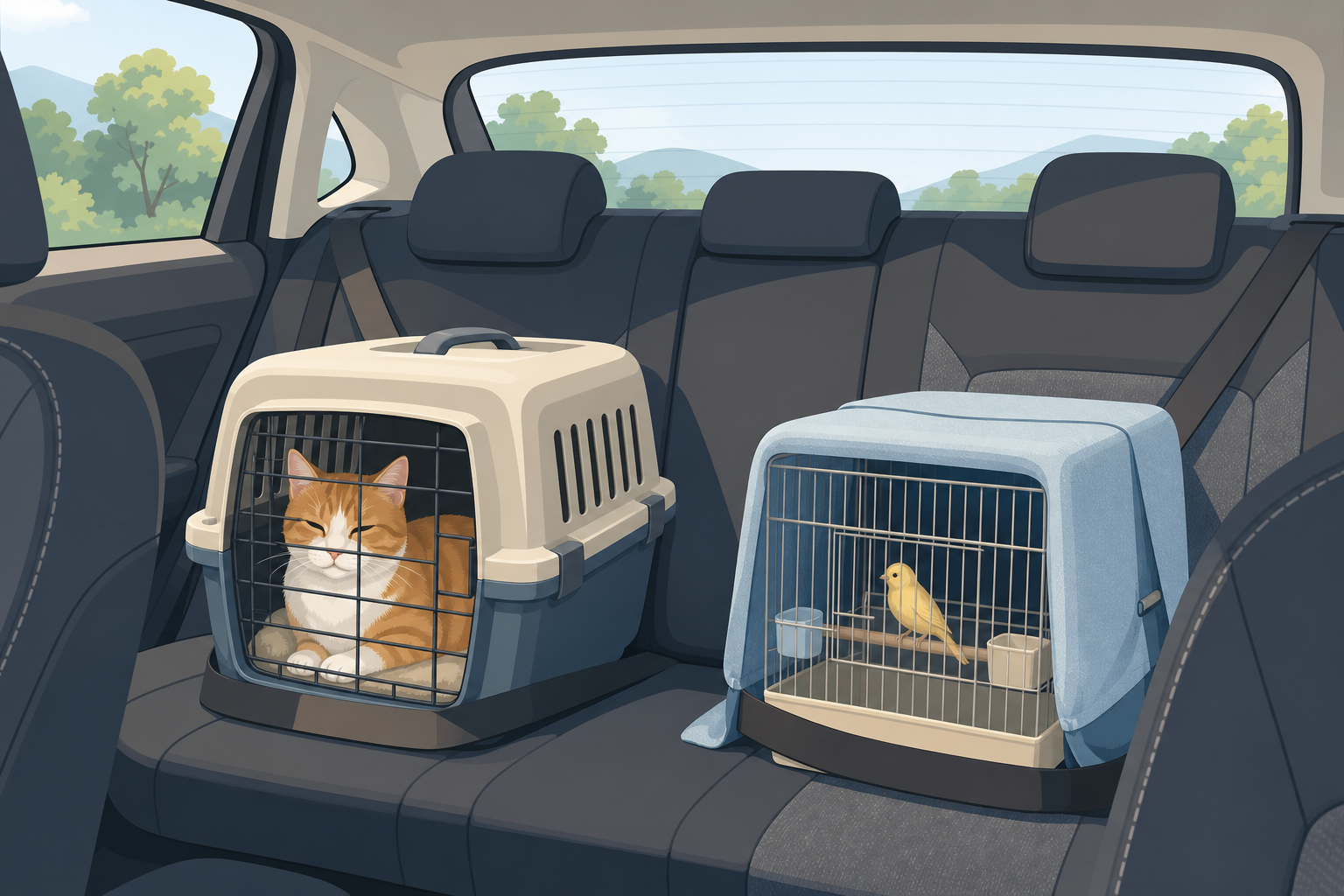
The safest solution, for both cats and birds, is therefore a closed, intact carrier secured so that it cannot slide, tip over, or open during braking.
How to Prepare a Cat
Choosing the Carrier
For a cat, a hard-sided carrier is generally preferable. It should be well ventilated and large enough to allow the cat to change position without being excessively roomy. Models with a top opening or a removable top section can make handling easier and help avoid having to pull the cat out by force S2.
You can place a familiar blanket on the bottom, ideally one that does not slip, and bring a spare cover as well. A light cloth over part of the carrier may help block visual stimuli, but it should not interfere with airflow.
Getting the Cat Used to It in Advance
If possible, leave the carrier open at home for a few days before the trip, with a familiar blanket and a few rewards inside. Then try short practice steps: close the door for a few seconds, lift the carrier while keeping it level, and finally take a few short drives. Gradual acclimation can make the transition from home to car less abrupt S2.
When carrying the cat in the carrier, support it from underneath rather than holding it only by the handle: reducing swinging and tilting helps provide better stability S2.
How to Prepare a Bird
A Dedicated Container Without Loose Items
A bird should never travel loose in the passenger compartment: sudden braking, an unexpected window opening, or abrupt movement can cause escape or injury S3. Use a travel cage or carrier designed for birds, one that is sturdy and has adequate ventilation.
For the trip, remove toys, swings, and hanging items that could strike the bird during a turn or sudden stop. The bottom can be lined with clean absorbent paper that is easy to replace. For longer journeys, a stable perch may be useful, but it should not be slippery or placed too high: if the bird loses balance, it should be able to fall without getting hurt [S3]S4.
Water and food require care. A full bowl can spill, wetting and chilling the bird; for this reason, it is better to bring fresh water and offer it during stops, or use only systems the bird already knows S3. Do not introduce a new water bottle or accessory for the first time on the day of travel.
Reducing Stimuli
Many birds can be frightened by moving traffic, reflections, and objects passing quickly outside the window. A light cover over one or more sides of the carrier can reduce stimulation while still leaving the ventilation openings clear S4. However, avoid prolonged complete darkness and check the bird’s behavior regularly.
Position, Temperature, and Ventilation
Cool or warm the car interior before placing the animal inside. The carrier should be kept away from direct sunlight, vents blowing hot or cold air, and drafts. The Italian Ministry of Health notes that a car can heat up quickly and that it is not safe to leave an animal alone inside, even with the windows partially open or when parked in the shade S5.
The carrier should be secured with the seat belt if the model allows it and should remain stable. For birds, it is prudent to avoid the front seat, where airbag deployment could crush the container; the back seat is generally a safer choice S3. For cats, do not use the closed trunk and do not let them roam freely inside the car S6.
Keep the environment calm: drive smoothly, keep music volume low, and avoid handling the animal while the vehicle is moving. Do not open the carrier outside a completely enclosed and secure area, because escape can happen in seconds.
Stops and Long Trips
Plan the route with extra time, choosing rest areas where you can check on the animal without exposing it to noise, heat, or escape risk. During a stop, the cat may be offered water and, on long trips, a portable litter tray in a separate and secure area; many cats, however, may not use it during travel S6.
For a bird, check that the carrier is clean, that the temperature is comfortable, and that water and food fit the bird’s usual routine. If you need to leave the car, always take the carrier with you: leaving it inside exposes the animal to overheating and theft S3.
When to Ask a Veterinarian for Advice
It is sensible to contact a veterinarian before departure if the animal is elderly, has a previously diagnosed condition, has had major stress episodes during past trips, must face a very long journey, or has specific circumstances that may make transport more demanding.
Do not give sedatives or other products on your own initiative. For birds, the use of tranquilizers during travel can involve risks and should be ruled out unless advised otherwise by a veterinarian experienced in exotic animals S3. For cats as well, any medication should be assessed and prescribed by a veterinarian based on the animal’s condition and the type of journey.
If during transport you notice breathing difficulty, marked weakness, loss of balance, overheating, wounds, or strongly abnormal behavior, stop the journey safely and seek veterinary assistance. This guide provides general preventive information and does not replace a professional evaluation.
Checklist Before Departure
- Carrier intact, closed, and secured.
- Blanket or non-slip lining for the cat.
- Absorbent paper, usual food, and water for the bird.
- No loose toys or dangerous objects in the travel cage.
- Car interior already tempered, ventilated, and out of direct sun.
- Veterinarian’s phone number and emergency contacts.
- Stops planned, without leaving the animal alone in the car.
- Health documents and entry requirements checked if traveling across borders: rules may vary depending on the species and the destination country S7.
Sources
- [S1] Art. 169 - Trasporto di persone, animali e oggetti sui veicoli a motore — Automobile Club d’Italia
- [S2] Taking your cat to the veterinary clinic — International Cat Care
- [S3] Transporting Your Bird - Car and Air Travel — VCA Animal Hospitals
- [S4] Moving With Your Bird? How To Reduce Stress For Everyone — Lafeber Company
- [S5] Come proteggere dal caldo cani e gatti — Ministero della Salute
- [S6] Moving house and travelling with cats — Blue Cross
- [S7] Trasporto degli animali d’affezione — Ministero della Salute