Travelling with an Older, Young or Sensitive Animal: How to Prepare
Animal welfareA practical guide to preparing the timing, breaks, environment and communication needed to transport older, young or particularly sensitive animals safely and in line with veterinary advice.

In this guide
A journey can be more demanding for an older, very young or easily stressed animal. There is no single solution for every animal: age, habits, species, journey length, method of transport and general condition should all be considered together. The Italian Ministry of Health identifies journey duration, driving methods and environmental conditions as relevant factors in animal welfare during transport S1. (salute.gov.it)
This guide helps you organise the journey and communicate the animal’s needs clearly. It does not replace a veterinary assessment, particularly if the animal has health problems, is receiving treatment or has previously struggled during travel.
Before departure: decide whether and how to travel
For an older or fragile animal, ask your veterinarian whether the planned journey is compatible with its condition and the duration of the trip. In uncertain cases, the Italian Ministry of Health’s transport guidance notes that fitness to travel may need to be certified by a veterinarian; animals that cannot walk independently and without suffering must not be transported S2. (salute.gov.it)
A puppy should also travel in conditions appropriate to its age and any health requirements applying at the destination. If the journey crosses an international border, check identification, documents, vaccinations and the destination country’s rules well in advance: the Italian Ministry of Health distinguishes between non-commercial travel and other types of movement S7. (salute.gov.it)
Before booking, consider:
- the total duration, including waiting times, changes and transfers between vehicles;
- whether stops can be made in safe, quiet places;
- the expected temperature and ventilation;
- how accessible the vehicle or handover point will be;
- the availability of water, the animal’s usual food, prescribed medication and documentation;
- whether a familiar person can accompany or meet the animal, where possible.
Prepare the animal gradually
A journey undertaken without preparation can be more difficult, especially if the animal associates transport only with unpleasant experiences. For dogs and puppies, it may help to begin with short periods in a stationary vehicle, followed by very brief journeys to positive destinations. Gradual exposure and positive associations are also recommended in veterinary guidance on travelling by car S3. (vcahospitals.com)
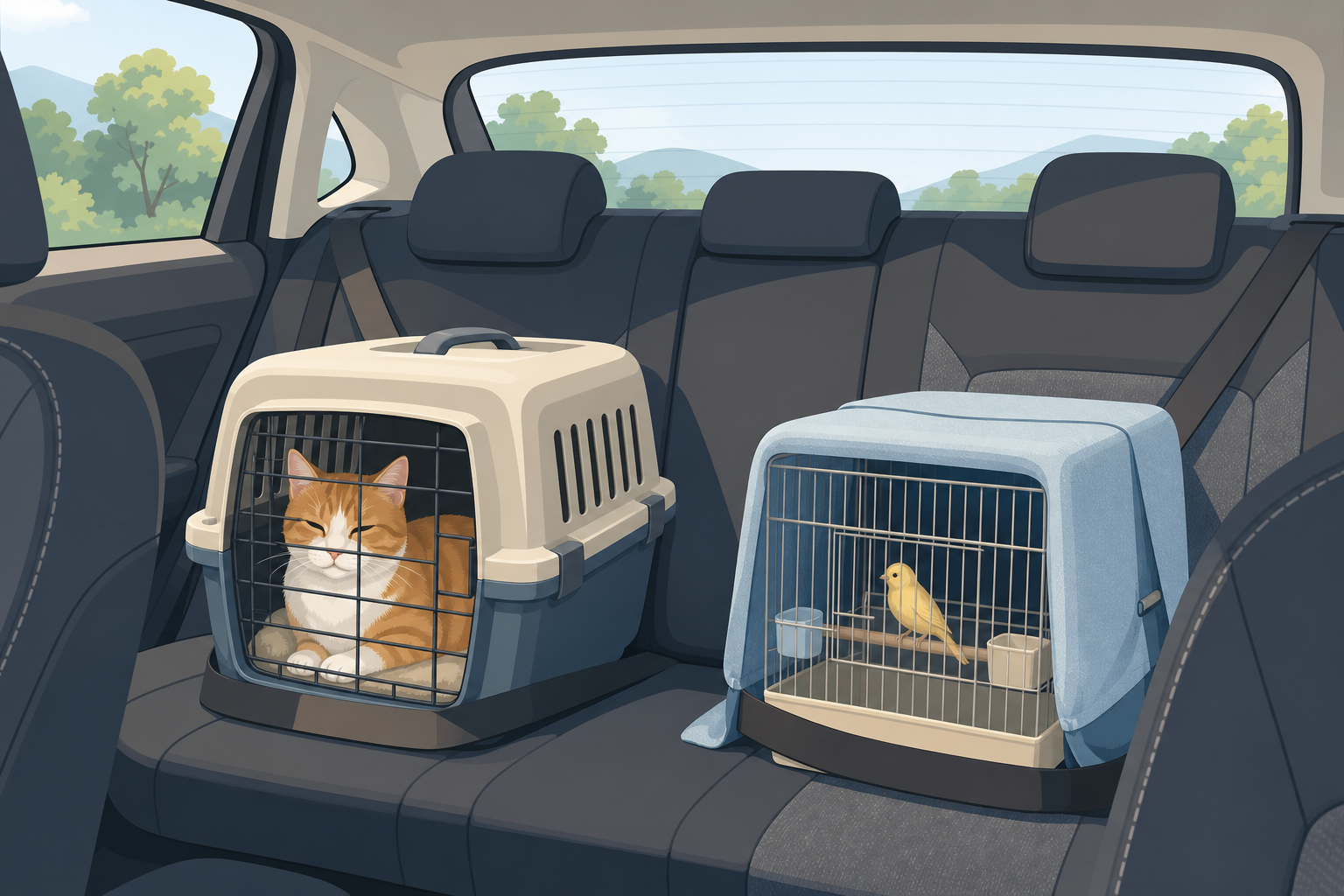
Introduce the carrier in advance by leaving it open at home and making it a familiar place. A blanket that already carries the animal’s scent may help maintain familiar smells. For cats, International Cat Care recommends minimising carrier movement, keeping it level and supporting it from underneath rather than carrying it only by the handle S4. (icatcare.org)
Do not force the animal to continue a practice session if it shows clear signs of fear or distress. It is better to stop, reduce the difficulty and try again later, or seek support from a veterinarian or a suitably qualified animal behaviour professional.
Choose and prepare the travel environment
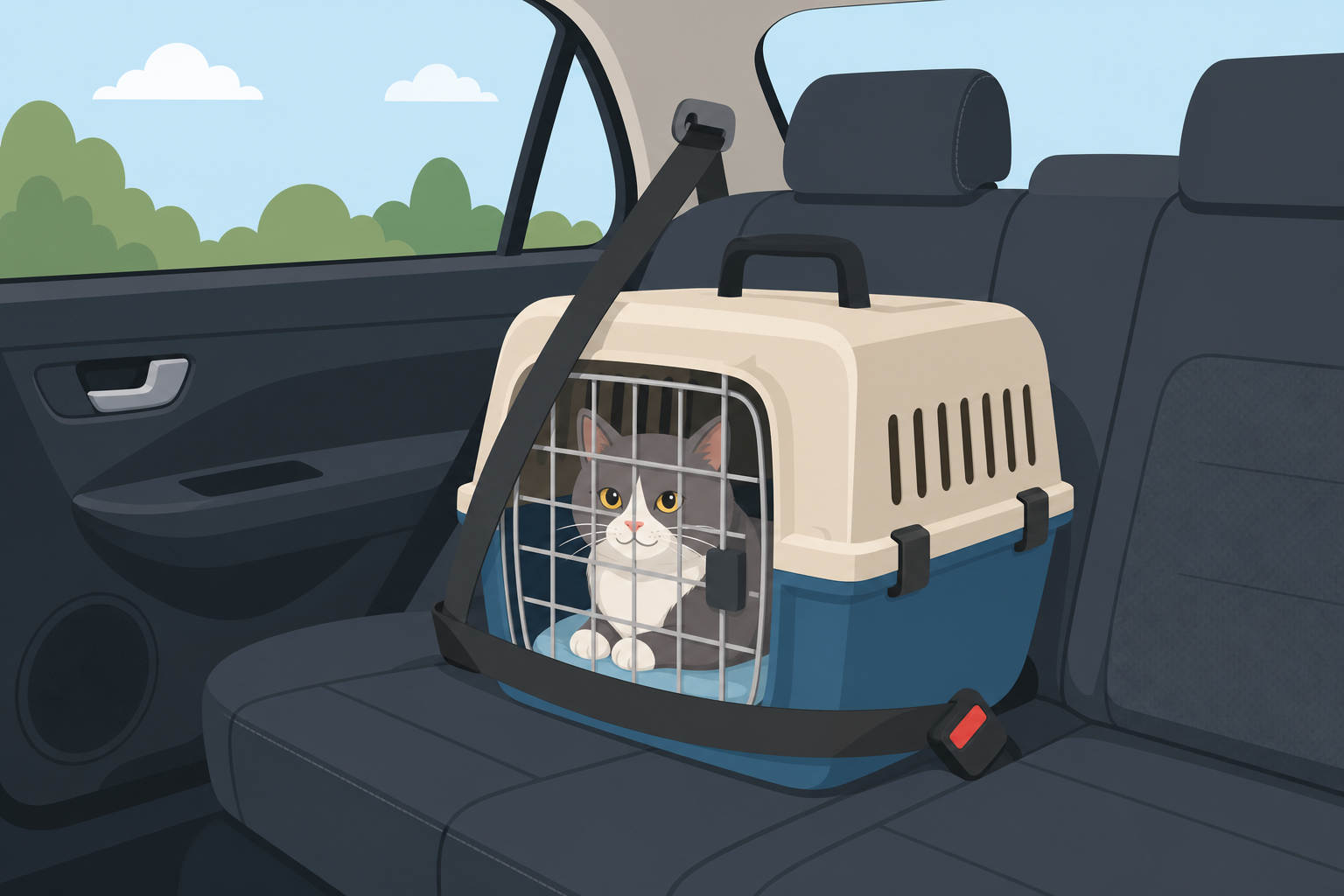
The restraint system must prevent escape and dangerous movement without restricting the animal. In Italy, the Highway Code prohibits transporting an animal in a way that creates an obstruction or danger to the driver. When transporting several animals, it requires a suitable cage or container, or a rear compartment separated from the driver by a mesh or another appropriate means S5. (aci.it)
In practice:
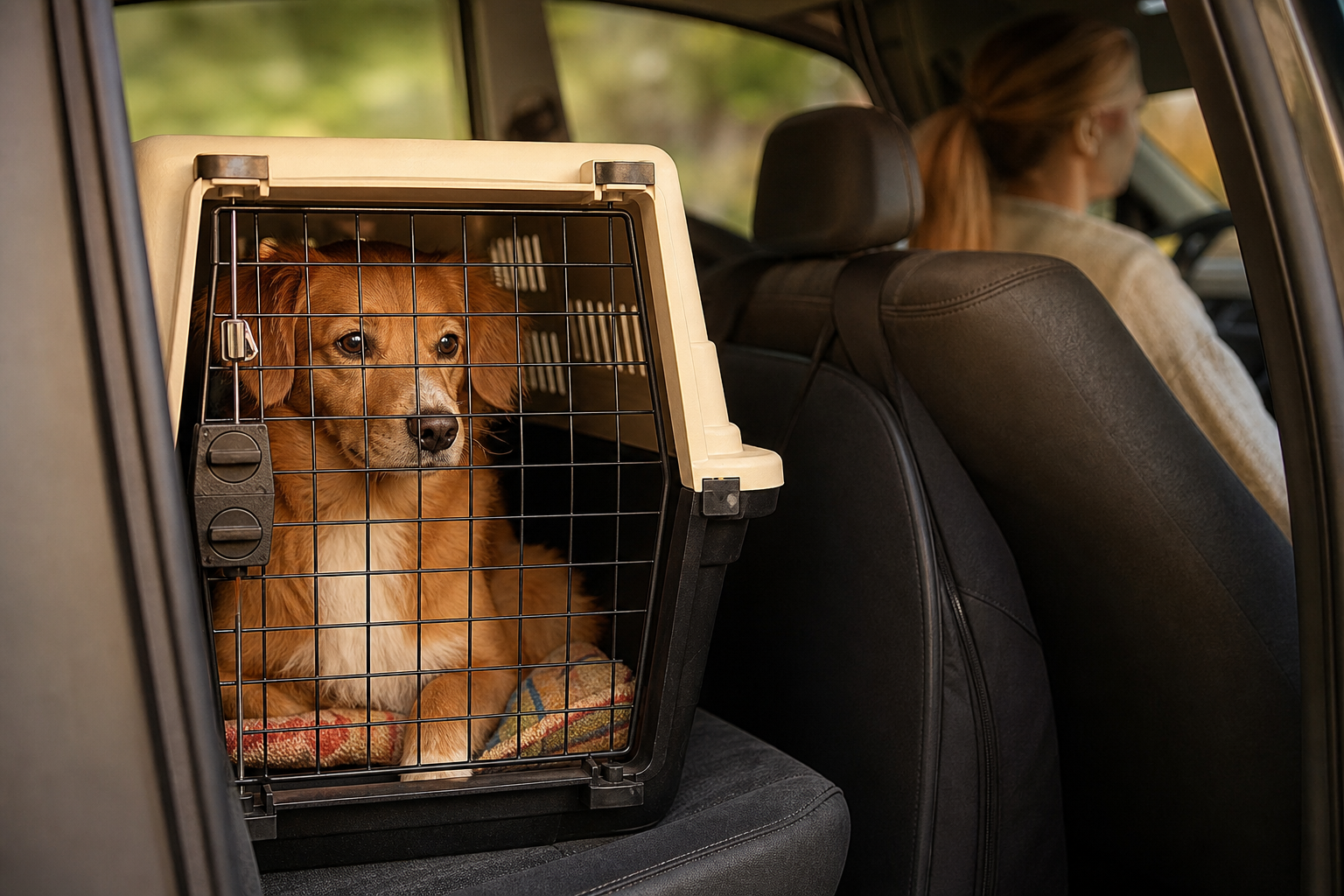
- choose a carrier large enough for the animal to adopt a natural position, turn around and lie down;
- secure it so that it cannot slide or overturn;
- use a non-slip base and absorbent material, with spare supplies ready;
- maintain adequate ventilation while avoiding direct draughts;
- limit noise, loud music, bumps and sudden manoeuvres;
- have a lead or harness ready before opening doors or tailgates;
- never leave the animal unattended in a parked vehicle, especially on hot days. The interior temperature can become dangerous quickly S6. (rspca.org.uk)
For an older animal, extra padding and a stable surface may be helpful, provided the material does not reduce the available space or obstruct airflow. For a puppy, bring spare supplies, wipes, bags and a small kit for possible accidents. For a particularly sensitive cat, partially covering the carrier may reduce visual stimuli, while keeping ventilation completely clear S4. (icatcare.org)
Plan journey times and breaks
Do not plan breaks based on distance alone. A journey lasting only a few hours may require more stops if the animal is young, old or easily agitated. Schedule additional checks of the animal’s position, temperature, apparent breathing, access to water and the condition of the carrier.
Stops should take place in safe areas away from traffic, with the dog secured before opening the vehicle door. For cats, it is generally safer not to open the carrier outdoors: a break can involve checking the animal, changing the absorbent material and maintaining a stable environment while preventing escape.
For long journeys, ask the transporter how stops are organised, who checks the animal and how delays, hot weather, bad weather or diversions are handled. The Italian Ministry of Health emphasises the importance of considering both the animal and its surroundings and, for transport covered by specific legislation, also requires attention to emergency management S1. (salute.gov.it)
Communicate with the transporter in advance
Advance communication is especially important when the animal does not cope well with noise, needs help moving or may react badly to unfamiliar people.
Provide the following in writing:
- species, age, size and relevant characteristics;
- any difficulties previously observed during journeys, waiting times or changes of environment;
- usual feeding habits and meal times;
- the need for more frequent breaks or assistance when loading and unloading;
- the owner’s and treating veterinarian’s contact details;
- prescribed medication, with instructions already agreed with the veterinarian;
- documents, microchip details, passport or certificates required for the route;
- information about people, noises, other animals or types of handling to avoid.
Also ask for confirmation of the carrier, ventilation, temperature, estimated duration, handover arrangements and procedures in case of delay. A responsible transporter should be able to explain how the animal will be kept safe and what information is needed before departure.
Medication and sedatives: never improvise
Do not give sedatives, anti-nausea medication or calming products on your own initiative. The Italian Ministry of Health’s guidance specifies that sedatives should be used only when strictly necessary for the animal’s welfare and under veterinary supervision S2. (salute.gov.it)
If the veterinarian considers treatment appropriate, ask how to prepare it, when to administer it and what to monitor. Do not try a product for the first time on the day of travel: any instructions and checks should be agreed with the professional in advance.
Essential checklist
Before departure:
- veterinary assessment, if needed;
- a suitable carrier or restraint system that has already been tested;
- water, the animal’s usual food, a bowl, absorbent material and spare supplies;
- prescribed medication and written instructions;
- documents, contact details and the animal’s identification number;
- an itinerary with stops and a backup plan;
- written confirmation with the transporter.
During the journey:
- smooth driving and a well-ventilated environment;
- scheduled checks without opening the carrier in unsafe places;
- more frequent stops if the animal shows distress;
- never leave the animal alone in the vehicle;
- promptly inform the owner about changes or unexpected events.
Planning further ahead does not mean making the transfer unnecessarily complicated: it means reducing uncertainty. For an older animal, a puppy or a particularly sensitive companion, realistic timings, a stable environment and shared information are often the most useful tools for making the journey safer and more predictable.
Sources
- [S1] Trasporto — Ministero della Salute
- [S2] Manuale per la gestione del controllo del benessere animale durante il trasporto su strada — Ministero della Salute
- [S3] Dog Behavior and Training - Traveling - Air and Car Travel — VCA Animal Hospitals
- [S4] A guide to creating a Cat Friendly Clinic Part 3 B — International Cat Care
- [S5] Art. 169 - Trasporto di persone, animali e oggetti sui veicoli a motore — Automobile Club d’Italia
- [S6] Taking Your Pet on Holiday — RSPCA
- [S7] Trasporto degli animali d’affezione — Ministero della Salute