Pet Carrier Guide: How to Choose the Right Size and Position
Animal welfareA practical guide to choosing a dog or cat carrier, covering materials, sizing, ventilation, stability, car and air travel, and gradual acclimation.
In this guide
Choosing the right pet carrier means balancing safety, comfort, ventilation and practicality. A suitable carrier should contain the animal without allowing it to be thrown around, while still letting it change position and rest. The best choice depends mainly on the animal’s species, size, temperament and means of transport.
Before buying: identify the main use
There is no single ideal carrier for every situation. For a veterinary visit or a short car journey, a rigid, easy-to-clean model may be sufficient. Air travel is different: check the airline’s rules and the requirements that apply to the carrier in advance. IATA standards address, among other things, strength, closures, dimensions, ventilation and a leak-proof floor. [S1]S2
For trains, ferries and other forms of public transport, always check the carrier’s conditions before departure. The Italian Ministry of Health provides specific information on travelling with animals by car, train, ship, ferry and plane. S7
Which model should you choose?
| Model | Strengths | When to consider it | Points to check |
|---|---|---|---|
| Rigid plastic | Stable, durable and easy to clean | Cats, small dogs and car journeys | Check the quality of the closures and ventilation |
| Metal or wire-sided | Good airflow and visibility | Animals used to confinement and some dogs | May be heavier and offer less protection from external stimuli |
| Soft-sided | Lightweight and easy to carry | Short journeys, if accepted by the carrier | It must retain its shape and not compress the openings |
| Backpack or bag | Convenient for short journeys on foot | Small animals that are already accustomed to it | Check interior space, stability and ventilation; some models are poorly suited to cats because they restrict movement S3 |
| Reinforced carrier | Greater strength and security | Longer journeys or animals that try to escape | It must still provide adequate ventilation and space |
For most cats, a rigid carrier with both front and top openings is practical. It makes it easier to place the animal inside with less handling and, with some models, the top can be removed without having to pull the cat out. S3
How to calculate the correct size
The carrier should be large enough for the animal to stand in a natural position, turn around and lie down. However, it should not be so spacious that the animal can move uncontrollably during braking, cornering or lifting.
Measure the animal in a natural position:
- from the tip of the nose to the base of the tail;
- from the ground to the top of the head or ears, using whichever point is highest;
- across the widest part of the shoulders or body;
- from the ground to the elbow, if you need to compare the measurements with formulas for air transport.
For containers intended for air travel, IATA uses as a reference an internal length equal to the animal’s length plus half the height from the ground to the elbow. The internal height must accommodate the animal in a natural position and include the thickness of the bedding; the width must allow the animal to turn around without difficulty. The final dimensions still depend on the species, the container and the airline. S1
A simple check before buying
Place the bedding or mat you plan to use during the journey inside the carrier and check that the animal can:
- enter without bending in an unusual way;
- turn around completely;
- lie down on its side;
- maintain a natural posture;
- have enough room for a bowl or watering system, if needed.
For a cat, a contained but not cramped space is preferable. An excessively large carrier may allow the cat to slide around and increase instability. S3
Ventilation, materials and closures
Openings should be distributed to promote airflow without creating places where paws, the muzzle or a collar could become trapped. For air-transport containers, IATA requirements specify technical details concerning ventilation and construction, so it is not enough for a product to be described simply as “for travel.” S2
Check that:
- the floor is solid, non-slip and leak-proof;
- internal edges are smooth;
- the door cannot be bent or opened by the animal;
- hinges and locking systems are robust;
- the lid cannot accidentally separate from the base;
- the material is washable and does not retain odours;
- handles and shoulder straps do not cause the carrier to tilt.
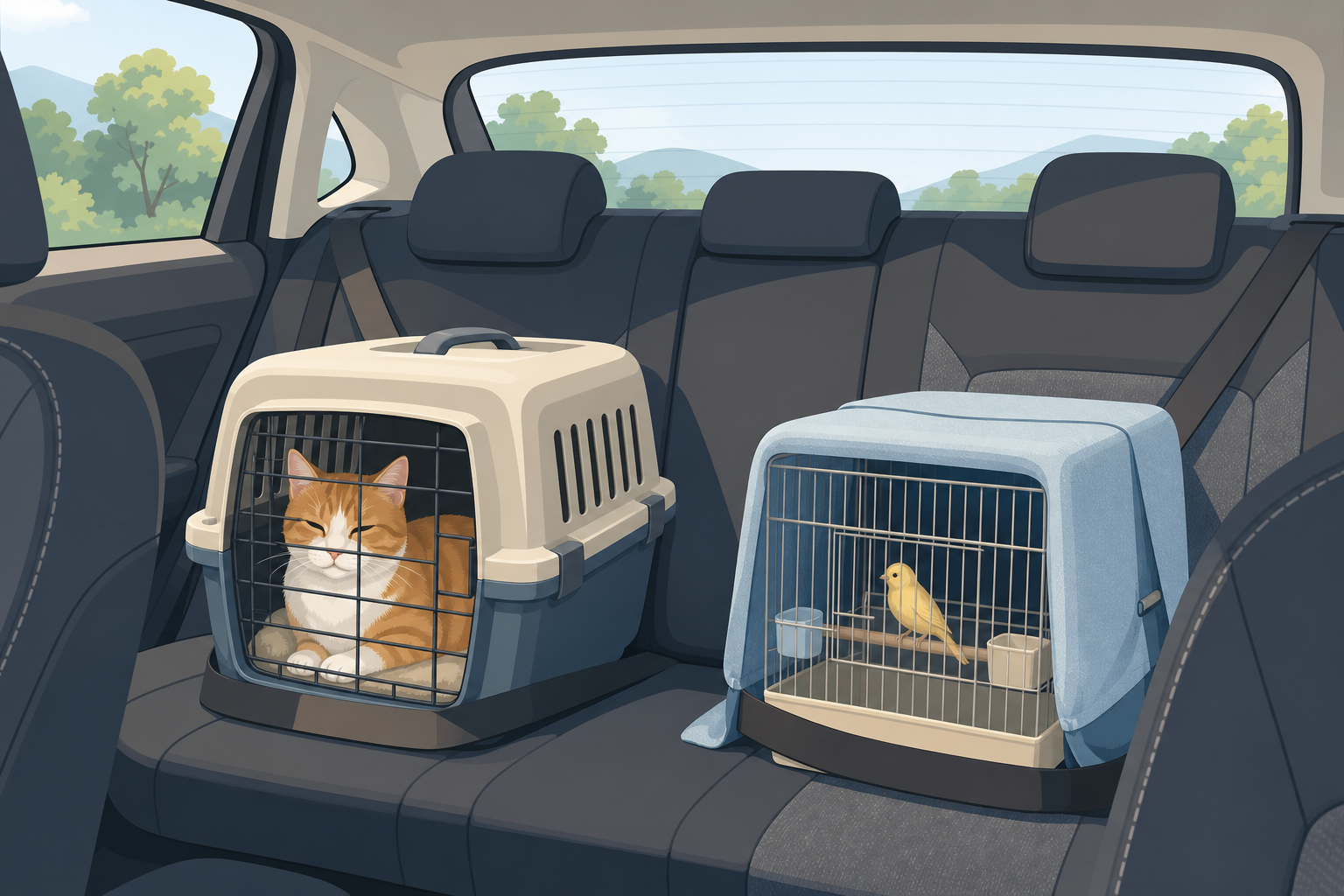
Avoid completely covering the openings with blankets or covers. A lightweight cover may partially block the view for a sensitive cat, but it must not reduce ventilation or increase the internal temperature. S3
Where should the carrier go in the car?
In a car, the carrier should remain stable, upright and separate from the driver. Article 169 of the Italian Highway Code prohibits transporting animals in conditions that could obstruct or endanger driving. It also permits the use of a cage or container, or a separated rear compartment protected by a suitable net or equivalent device. S4
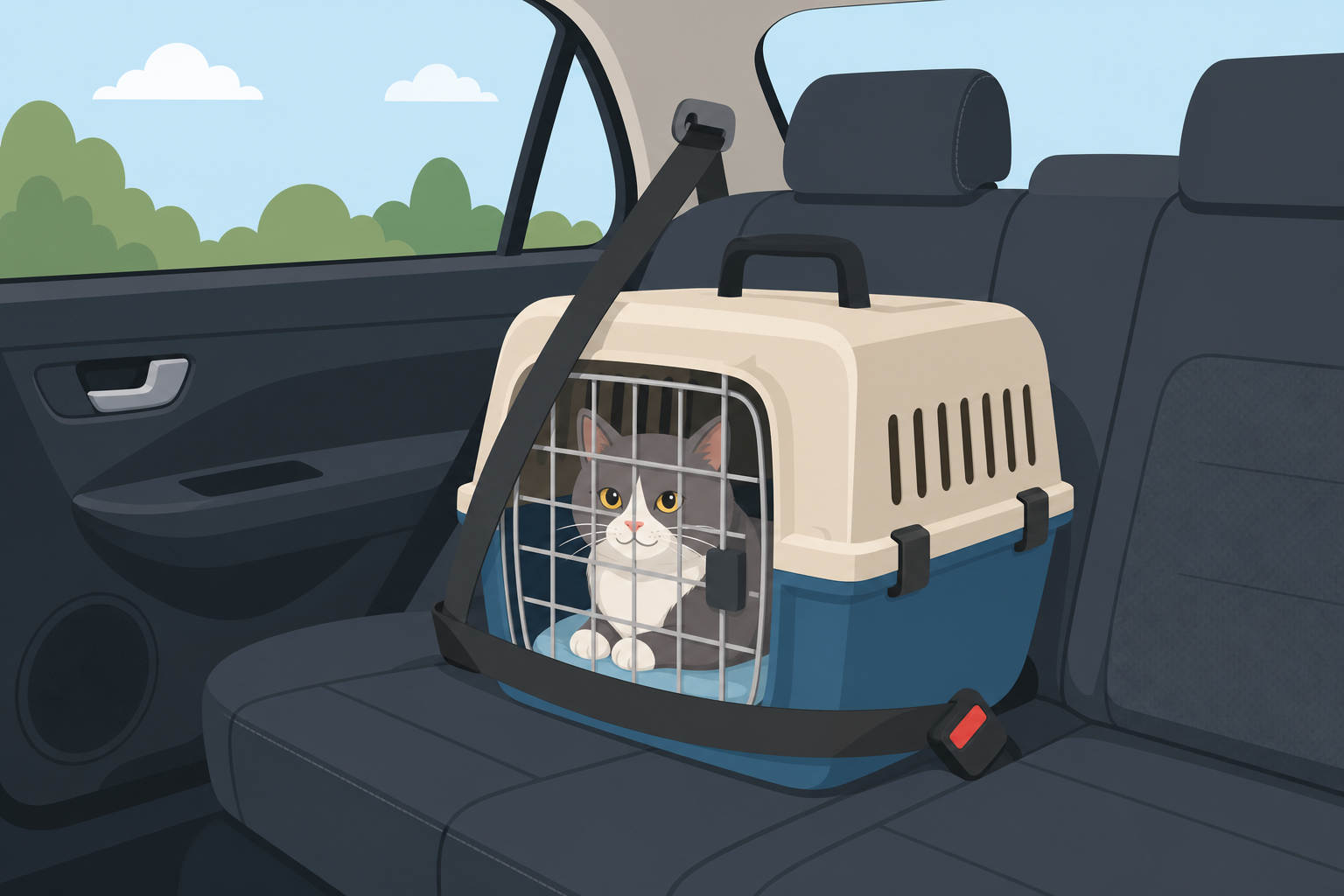
For a cat or small dog, a practical option is the rear seat, with the carrier kept level and secured according to the manufacturer’s instructions. Do not leave it loose on the seat, on the floor or in the luggage compartment: during sudden braking, it could slide or be thrown forward. Animal welfare organisations recommend securing it with the seat belt and not allowing the animal to roam freely inside the vehicle. [S3]S6
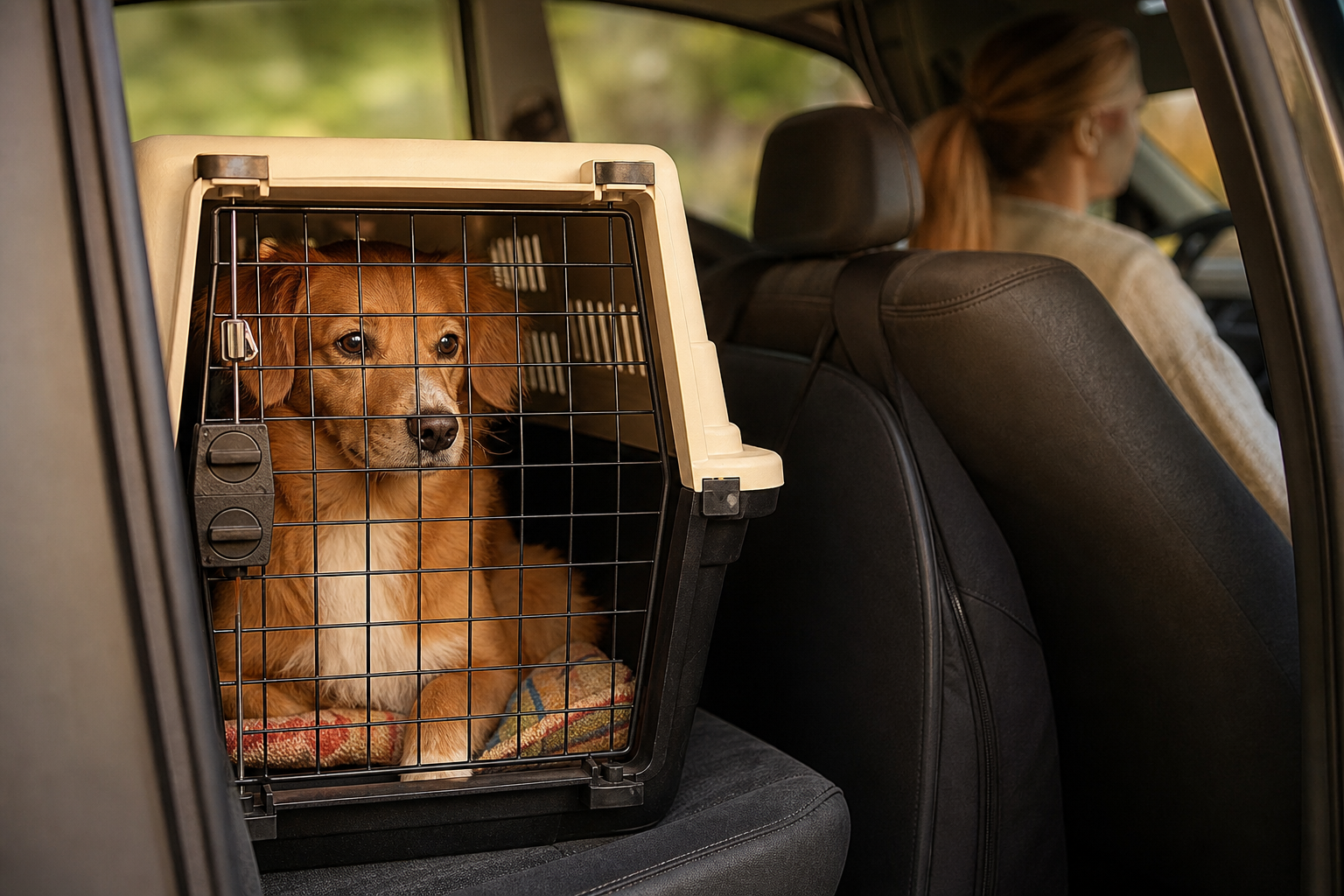
For medium-sized or large dogs, consider a system suited to their size: a rear compartment separated by a suitable barrier, a sufficiently robust carrier, or a harness and safety device designed for use in a car. The solution must prevent the animal from reaching the driver and must be compatible with the vehicle.
Do not place the carrier on the front seat, especially in front of an active airbag. Also avoid the enclosed luggage compartment of a saloon car, where ventilation may be inadequate. Never leave an animal unattended in a car in high temperatures: a hot vehicle interior can cause severe distress. [S4]S6
How to acclimate a dog or cat gradually
Acclimation should begin before the journey, not on the day of departure. Leave the carrier open in a quiet area of the home, with a familiar-smelling blanket and a few treats. When the animal enters voluntarily, gradually increase the time with the door closed. Then try lifting the carrier for a few seconds and taking short trips. Continue only while the animal’s behaviour remains manageable, and avoid forcing it. [S3]S5
For a dog accustomed to a kennel, associate the carrier with positive experiences and slowly increase the time spent inside. For a cat, avoid chasing or dragging it into the carrier unless necessary: gradual training can reduce the association between the carrier and unpleasant situations. [S3]S5
During the journey, use an absorbent pad, a familiar blanket and a spare. For longer trips, plan stops, water and a safe way to manage the animal’s needs. Do not open the carrier in an unprotected place: a frightened animal can escape very quickly. S6
International travel: the carrier is not the only requirement
For non-commercial travel within the European Union with a dog, cat or ferret, requirements may include identification by microchip, a rabies vaccination and specific documents, including an EU pet passport. Conditions depend on the country of departure, the destination and whether the animal is entering from a non-EU country. Always check the official rules before booking the ticket. S5
Final checklist
Before setting off, check that:
- the carrier is the correct size;
- the door, hinges and closures work properly;
- the floor is stable, clean and absorbent;
- the openings are not obstructed;
- the carrier is secured correctly in the vehicle;
- the animal has completed short, gradual practice sessions;
- water, spare bedding and the necessary documents are available;
- the carrier has confirmed its own rules;
- the journey will not expose the animal to excessive heat or an unattended stop in the car.
The best choice is not necessarily the largest or most expensive model. It is the one that provides functional space, ventilation, stability and reliable closures for the animal and the type of journey involved.
Sources
- [S1] Traveler’s Pet Corner: guidance for pet containers and dimensions — IATA
- [S2] Live Animals Regulations: Container Requirements 1, cats and dogs — IATA
- [S3] Choosing and Using a Cat Carrier — Cats Protection
- [S4] Articolo 169 del Codice della Strada: trasporto di persone, animali e oggetti — Polizia di Stato
- [S5] Travelling with a pet within the EU — Commissione europea
- [S6] Car travel with your dog — Blue Cross
- [S7] Trasporto degli animali da compagnia — Ministero della Salute