Traveling by Car With Your Dog: Rules, Safety and Preparation
Transport guidesHow to transport a dog safely by car while following Italian rules: choosing the right restraint, organizing the vehicle, planning breaks, managing heat and considering BauBauCar.

In this guide
Traveling by car with your dog: what to know before leaving
Transporting a dog by car means more than simply helping the animal into the vehicle. The dog must be carried in a way that does not restrict the driver's freedom of movement or create an obstruction or danger while driving. In Italy, the main reference is Article 169 of the Italian Highway Code. S1
Careful preparation helps make the journey safer and more predictable. Choose a suitable restraint system, organize the passenger compartment correctly, plan regular breaks and pay particular attention to high temperatures.
What the Italian Highway Code provides
Article 169 allows a pet to be transported as long as it does not obstruct or endanger driving. If more than one animal is transported, they must be kept in a suitable cage or container, or in the rear compartment separated from the driver's area by a net or another appropriate means. When a net is installed permanently, it must be authorized by the competent offices. S1
In practice:
- the dog should not be loose in the passenger compartment if it can reach the driver or interfere with the controls;
- it must not be carried on the driver's lap;
- it should not travel in the front seat, especially when an active airbag is present;
- transporting multiple dogs requires a container, a separated area or an equivalent system provided for by the law;
- the cargo area may be used only if it provides adequate space, ventilation and protection, and is not an unsuitable enclosed compartment.
The law establishes the minimum conditions for lawful transport. For everyday safety, using a restraint system is generally preferable even when traveling with only one dog.
Choosing the right restraint
There is no single solution that suits every dog. The choice depends on the dog's size, the vehicle's layout, the length of the journey and the animal's ability to remain calm while traveling.
Carrier or crate
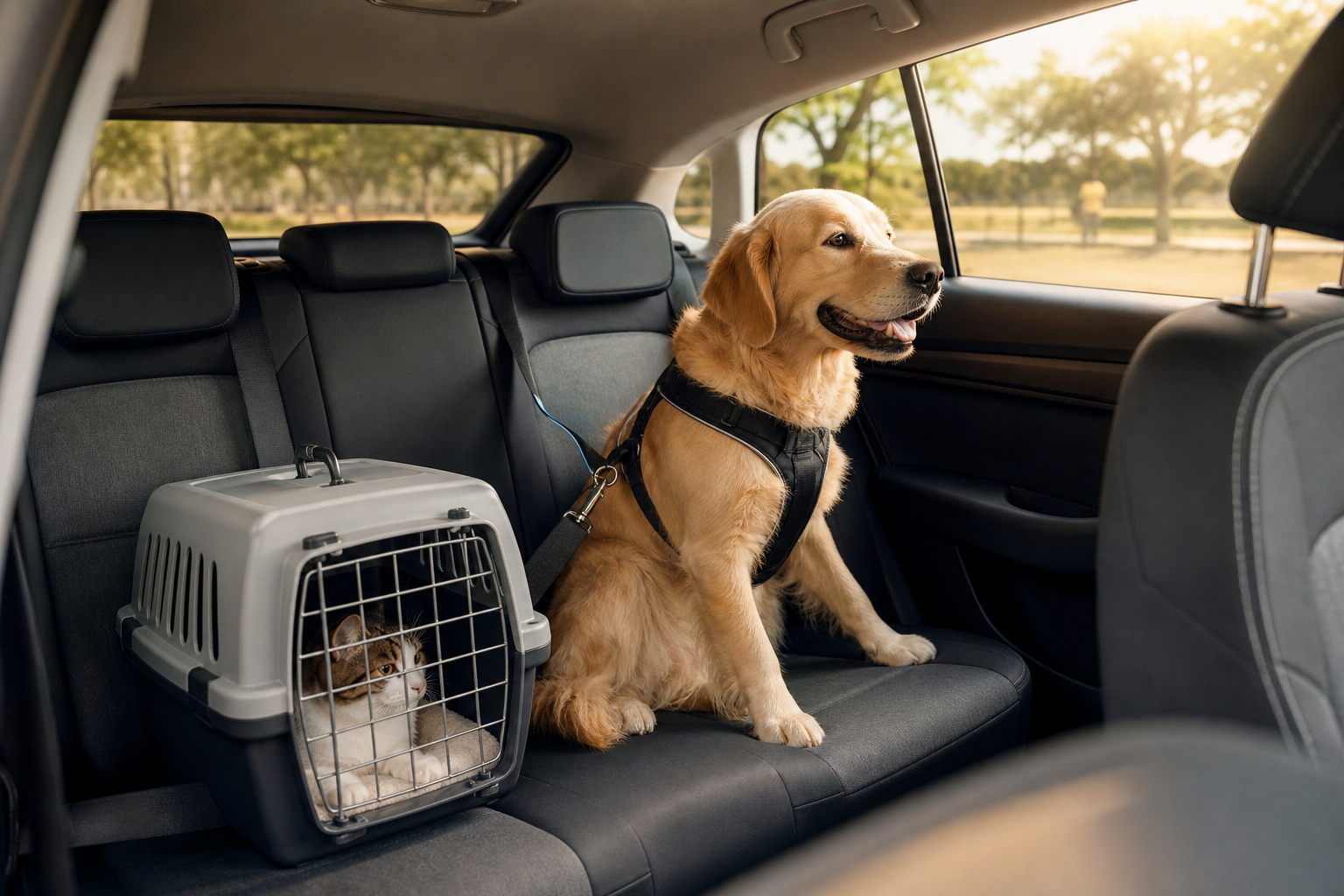
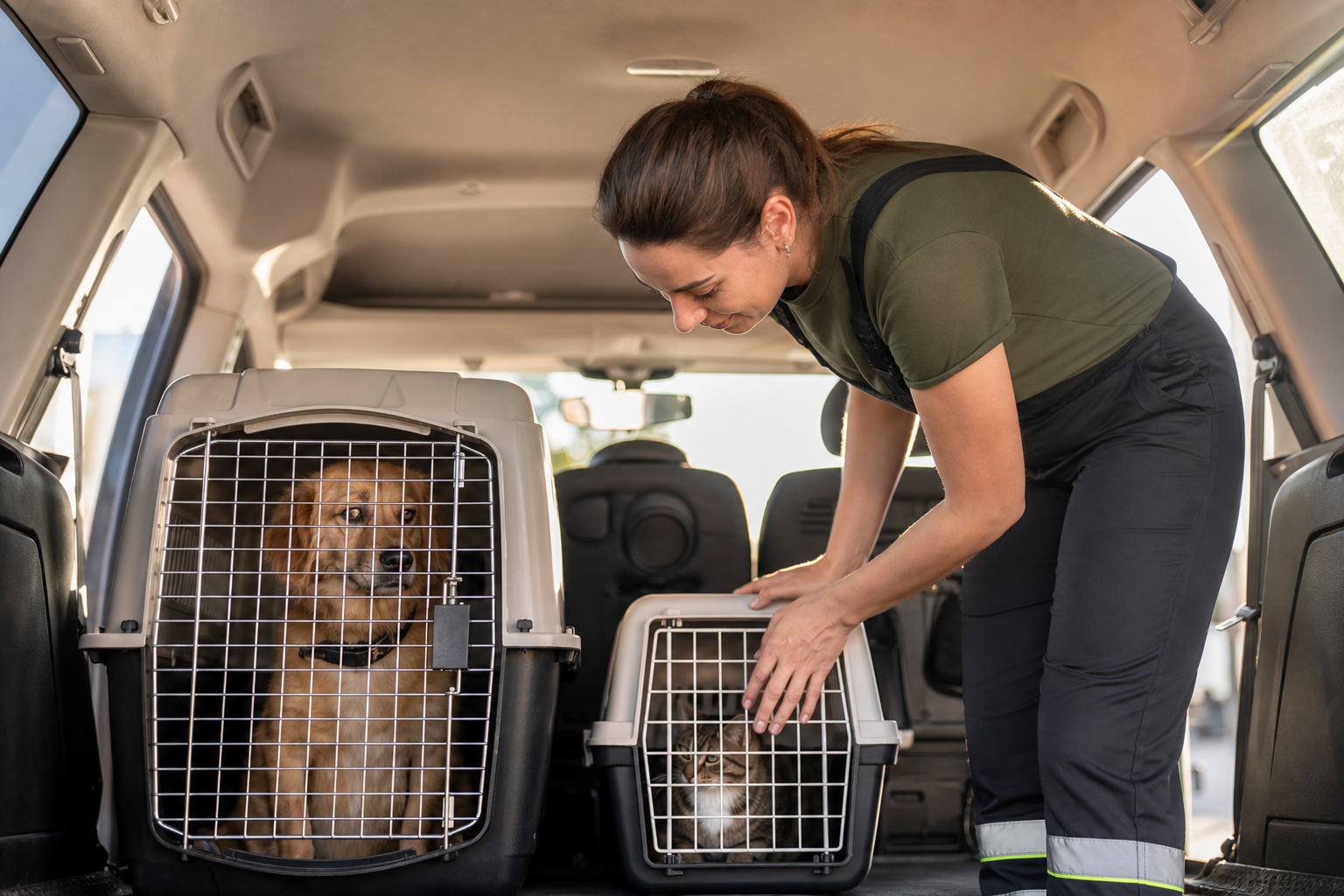
A carrier is often suitable for small and medium-sized dogs if it is large enough for the dog to stand, turn around and adopt a comfortable position. It should be stable, well ventilated and positioned so it cannot slide or overturn.
If it is placed on the rear seat, secure it according to the manufacturer's instructions. An unsecured carrier can move during sudden braking, even with the dog inside. For larger dogs, a sturdy crate may be placed in the rear cargo area, provided that the space is properly arranged and separated from the driver.
Harness connected to a seat belt
A car-specific harness can be a practical option for the rear seat. Connect the system to the harness rather than attaching the leash directly to the collar: during a sudden movement, a collar can place inappropriate pressure on the neck.
Before a long journey, gradually familiarize the dog with the harness and the sound of the car through short trips. The American Veterinary Medical Association recommends preparing the animal in advance and not allowing it to travel loose on the seat or in a passenger's arms. S4
Net or divider
For dogs traveling in the rear cargo area, a divider can prevent access to the driver's area. The net must be stable, correctly installed and compatible with the vehicle. If installed permanently, it must meet the conditions set out in Article 169. S1
A divider does not replace other safety considerations: the dog must have enough space, fresh air, protection from direct sunlight and a surface that prevents slipping.
Organizing the passenger compartment
Before leaving, remove loose objects that could fall or strike the dog during braking. Protect the seat or rear cargo area with a blanket or nonslip surface, while keeping air vents and ventilation routes clear.
Keep the following within reach:
- water and a collapsible bowl;
- a leash and spare harness;
- waste bags and absorbent material;
- a blanket or familiar item;
- documents and useful contact details;
- the dog's usual food, without suddenly changing its routine.
The dog should not travel with its head out of the window: dust, debris and wind can irritate or injure the eyes, ears and nose. S4
Before departure
For short trips, a calm walk before getting into the car may help the dog release energy and relieve itself. Avoid intense physical activity immediately before departure.
If the dog is not used to traveling by car, proceed gradually:
- let it explore the stationary car without forcing it to get in;
- take short trips, preferably to pleasant destinations;
- slowly increase the length of the journeys;
- maintain a calm tone and drive smoothly;
- stop the training session if the dog shows clear signs of discomfort and ask a veterinarian for advice about travel-related problems.
The Italian Ministry of Health recommends preparing for the journey in advance, carrying an up-to-date health record and planning regular breaks. S2
Breaks, water and food
For long journeys, plan regular stops in safe locations. During each break, keep the dog on a leash: service areas, parking lots and rest areas can be noisy and busy.
Offer water at regular intervals, without forcing the dog to drink a large amount all at once. With food, maintain the usual routine as far as possible and ask a veterinarian about meal management if the animal experiences travel-related problems. Do not give medication or sedatives on your own initiative: any product should be assessed by a professional based on the individual dog's condition.
During a stop, check that the restraint system is still secure and make sure the dog cannot get out before its leash has been attached.
Heat in the car: a risk that should not be underestimated
Never leave a dog alone in a parked car, even with the windows slightly open or the vehicle parked in the shade. The passenger compartment can heat up quickly, and the Italian Ministry of Health considers this dangerous for animals. S3
On hot days:
- choose the coolest hours possible;
- check traffic and weather conditions before leaving;
- ventilate the passenger compartment before letting the dog in;
- use the air conditioning without directing the airflow straight at the animal;
- bring enough water to cover traffic jams or detours;
- plan stops in genuinely safe, ventilated places;
- do not leave the dog unattended while refueling or running an errand.
Puppies, older dogs, brachycephalic dogs, overweight animals and dogs with heart or respiratory problems may be more vulnerable to the effects of heat. The Ministry identifies panting, lethargy and staggering among signs that should be taken seriously. If concerning symptoms appear, contact a veterinarian immediately. S3
What to avoid during the journey
Some behaviors create unnecessary risks:
- allowing the dog to move freely between the seats;
- holding it on the driver's lap or near the pedals;
- using the collar as the only connection point to the seat belt;
- opening the window so the dog can put its head outside;
- placing heavy luggage beside or on top of the carrier;
- leaving without water or without planning breaks;
- leaving the animal alone in a parked vehicle;
- giving sedatives or remedies for motion sickness without veterinary direction;
- opening a door or the rear hatch before the dog has been secured.
Traveling outside Italy
If the destination is another country, check health and documentation requirements in addition to the rules for transporting the dog by car. For travel within the European Union, dogs, cats and ferrets generally must be identified, accompanied by a valid European pet passport and compliant with rabies vaccination requirements. Additional conditions may apply depending on the destination country and the place of origin. S5
Make these checks well in advance through the relevant veterinary services or by consulting current official guidance. Rules for non-commercial travel may differ from those applying to organized transport, changes of ownership or travel with multiple animals.
When to consider a professional service
Transporting a dog yourself is not always the simplest option. A journey can become difficult if the owner does not drive, cannot manage long trips, must travel on a specific date or cannot handle boarding, breaks and safety arrangements independently.
In these cases, a professional service such as BauBauCar may be a practical alternative to organizing the transport yourself. Before booking, ask for clear information about:
- the restraint methods used;
- how breaks and water are managed;
- ventilation and temperature control;
- communication during the journey;
- required documents and information;
- procedures for handing over and collecting the dog;
- how older, anxious or otherwise specific-needs animals are handled.
A reliable service should explain clearly how the journey is organized, without promising that every dog will travel without stress or that every situation will be suitable for transport. The owner should provide accurate information about the dog's size, habits, behavior, any difficulties already observed and the necessary documentation.
Final checklist
Before leaving, check that:
- the dog is secured with a stable system suitable for its size;
- the driver has full freedom of movement and visibility;
- the carrier or harness has been tested in advance;
- water, a leash, a blanket and emergency supplies are available;
- the route includes stops in safe locations;
- the car is ventilated and protected from heat;
- the dog will never be left alone in the vehicle;
- the documents are available, especially for cross-border travel;
- if a professional is handling the journey, the conditions and procedures have been clarified beforehand.
Transporting a dog responsibly by car means combining compliance with the rules, prevention and common sense. When the owner cannot manage the journey directly, choosing a transparent professional service can simplify the arrangements while keeping the animal's safety and well-being at the center.
Sources
- [S1] Art. 169 – Trasporto di persone, animali e oggetti sui veicoli a motore — Automobile Club d’Italia
- [S2] Consigli utili per viaggiare con i nostri animali — Ministero della Salute
- [S3] Come proteggere dal caldo cani e gatti — Ministero della Salute
- [S4] Traveling with Your Pet — American Veterinary Medical Association
- [S5] Passaporto per animali da compagnia — Ministero della Salute