How to Prepare Your Dog or Cat for a Car Journey
Transport guidesCarriers, gradual practice, essential supplies and planned breaks: a practical guide to making car travel safer and calmer for dogs and cats.
In this guide
A car journey may be easy for some animals and challenging for others. Preparation often makes the difference: gradually getting your dog or cat used to the carrier, organising the vehicle and planning suitable breaks can help reduce stress and unexpected problems.
This guide offers practical preparation tips and does not replace advice from a veterinarian. If your animal has already shown severe fear, travel sickness or other difficulties, it is wise to ask the veterinarian who cares for them for advice well before departure.
In the days before the journey: prepare calmly
Do not wait until departure day to introduce the carrier or attempt the first long journey. Leave the carrier open at home for several days in a quiet area, with a blanket or familiar-smelling item inside. You can reward your animal when they approach or enter it voluntarily, without forcing them.
For a dog, proceed in small steps: first stay near the car with the engine off, then sit inside for short periods, and finally try journeys lasting just a few minutes. For a cat, the carrier should become a familiar part of the environment rather than appearing only before a veterinary visit. Gradual familiarisation with the carrier and the car is recommended by leading veterinary and animal-welfare organisations. S2
Increase the length of practice sessions only if the animal remains manageable and does not appear excessively distressed. If one stage is too difficult, return to the previous one rather than insisting.
Choose and secure the transport system correctly
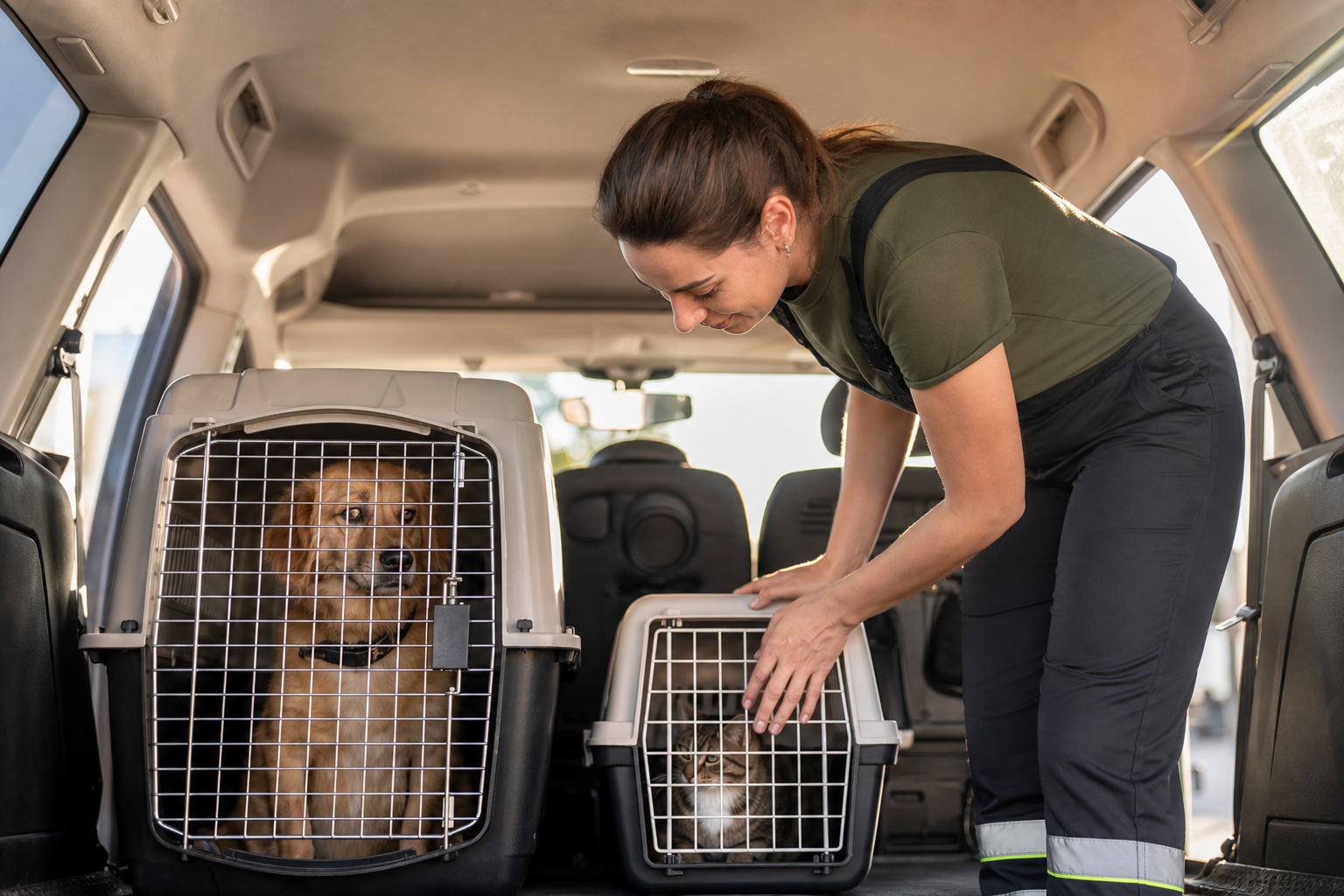
In Italy, a dog or cat must not be transported in a way that restricts the driver’s movements or creates a danger while driving. Article 169 of the Italian Highway Code lists the use of a suitable cage or container among the available solutions. When transporting more than one animal, it also allows a rear compartment separated from the driving area by a net or another suitable equivalent system. S1
In practice:
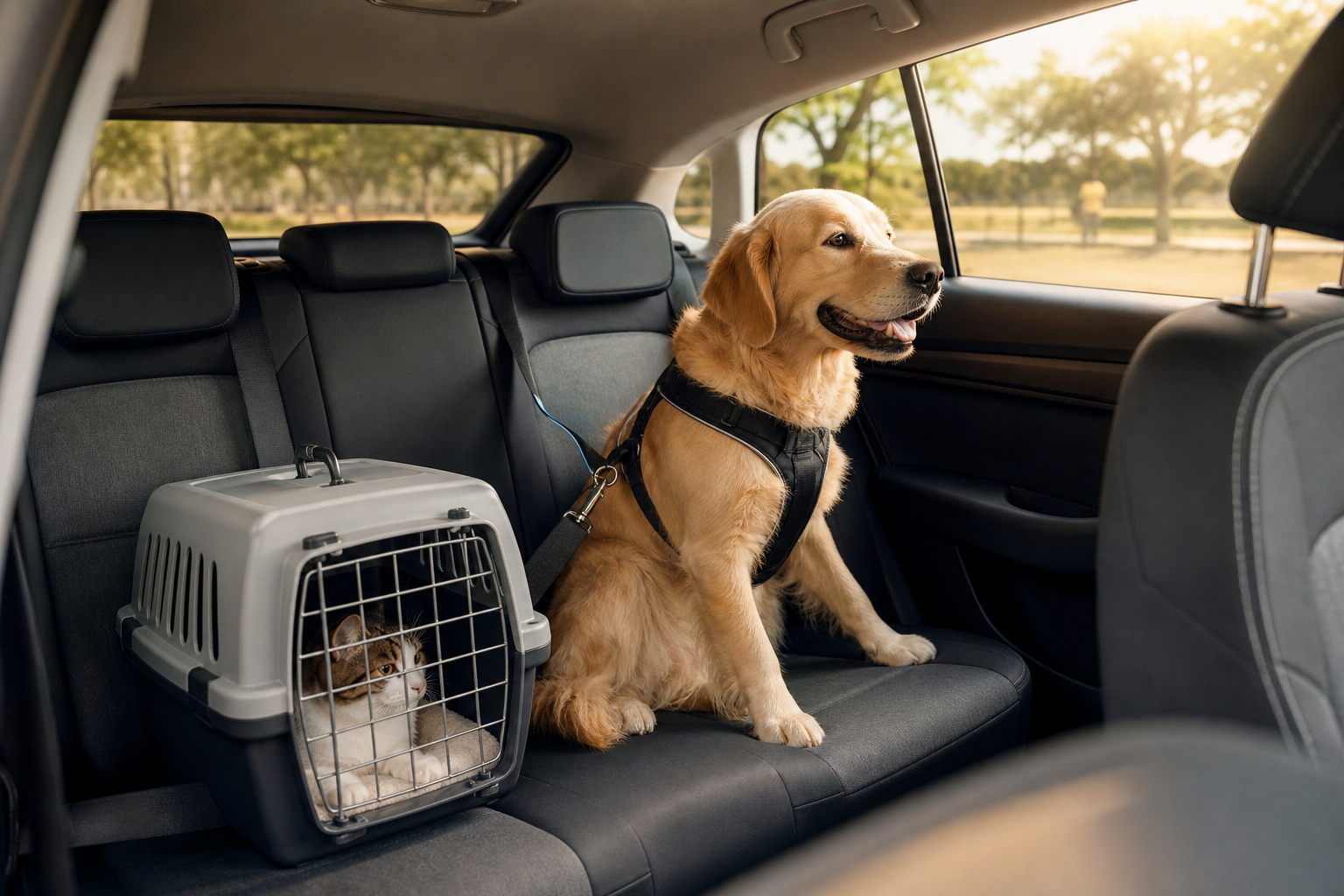
- use a sturdy, well-ventilated carrier that is suitable for the animal’s size;
- secure it so that it cannot slide or overturn during braking or turns;
- for a larger dog, consider a vehicle-compatible containment solution, such as a separating barrier or a suitable restraint system;
- do not leave the animal loose in the passenger compartment, on the floor or on a passenger’s lap;
- prevent the animal from reaching the pedals or gear stick, or obstructing the driver’s view.
The rear seat is generally preferable to the front seat. If the carrier is placed in the front, always check the instructions for both the vehicle and the device, especially regarding airbags.
What to pack in the travel bag
Prepare everything you need in an easily accessible bag rather than at the bottom of the boot. A useful checklist includes:
- water and a bowl, preferably a collapsible one;
- the animal’s usual food and a few small treats, without changing their diet during the journey;
- a blanket, towel and absorbent mat;
- a lead, harness and identification tag for a dog;
- a portable litter tray and some familiar litter for a cat;
- bags, wipes and cleaning supplies for the carrier;
- any medicines already prescribed by the veterinarian, kept in their original packaging;
- documents, the veterinarian’s contact details and the animal’s identification information;
- a recent photograph, which may be useful if the animal goes missing.
For journeys outside Italy, check the destination’s requirements well in advance. Dogs, cats and ferrets travelling to Italy or between European Union countries may require identification, documents and a rabies vaccination, depending on the rules that apply to the route. The Italian Ministry of Health recommends checking the documentation before departure. S2
On the day of departure
Keep the animal’s usual routine as much as possible. A quiet walk may help a dog travel after relieving itself, but avoid intense activity immediately before getting into the car.
For feeding, follow the animal’s usual habits and ask the veterinarian how to proceed if they have previously experienced nausea or other travel-related problems. In general, on long journeys it is preferable to avoid large meals immediately before departure. The AVMA suggests offering small amounts of food and water during long trips and planning regular breaks. S3
Before closing the doors, check that:
- the carrier or restraint system is secured;
- doors and windows are closed safely;
- the lead and harness are ready for breaks;
- water is within easy reach;
- the animal’s identification details are up to date.
Never leave a dog or cat alone in a car, even for a quick errand. The temperature inside a vehicle can become dangerous quickly, especially on hot days; a shaded vehicle or partly open windows is not a reliable solution. S3 S4
Managing breaks during the journey
Plan regular breaks and choose safe areas away from traffic. For a dog, a break should allow them to drink, move around briefly and relieve themselves. For long journeys, the AVMA gives a break approximately every two hours as a practical reference to allow a dog to exercise and go to the toilet. S3
During every break:
- put the dog’s lead and harness on before opening the car door;
- do not open a cat’s carrier outdoors: a sudden noise could cause the cat to escape;
- make sure the animal is not exposed to direct sunlight or high temperatures;
- offer small amounts of water and observe their behaviour;
- resume the journey only once the transport system is closed and secured again.
A cat may not use the litter tray at every break. On a very long journey, prepare a way to offer one in an enclosed, safe environment, never in an open service area.
When a car journey is too demanding
Some journeys involve many hours on the road, route changes, complicated stops or handling requirements that the owner may not be able to manage safely while driving. In these cases, considering a professional pet transport service may be useful, especially if it allows the journey to be entrusted to someone dedicated to the animal’s safety.
If you are considering a platform such as BauBauCar, first check the transporter’s profile, the type of vehicle, the containment arrangements, how breaks are managed, whether you can share information about the animal and what the plan is in case of unexpected problems. On long or stressful journeys, having a companion focused on the dog’s or cat’s wellbeing may make organisation easier, but it does not remove the need to prepare documents, the carrier and essential supplies.
Final checklist
Before setting off, ask yourself:
- Has the animal had at least a few practice journeys by car?
- Is the carrier or restraint system secured correctly?
- Do I have water, the usual food, a blanket and cleaning supplies?
- Have I planned breaks in safe places?
- Have I checked the documents and destination requirements?
- Can I manage the animal safely in traffic or if delays occur?
A gradual start, a stable environment and well-organised breaks cannot guarantee that every journey will be free of difficulties. They can, however, help create safer and more predictable conditions for everyone travelling, including animal passengers.
Sources
- [S1] Art. 169 – Trasporto di persone, animali e oggetti sui veicoli a motore — Automobile Club d’Italia
- [S2] Trasporto degli animali d’affezione — Ministero della Salute
- [S3] Traveling with Your Pet — American Veterinary Medical Association
- [S4] Taking Your Pet on Holiday — RSPCA