Transporting a Dog in the Car: Seat Belt or Carrier?
Transport guidesA harness, carrier, protective blanket and partition do not provide the same protection. Here is how to compare the options for travelling with your dog on the rear seat.

In this guide
The basic rule: your dog should not travel loose
A dog roaming freely on the rear seat can distract the driver and, during sudden braking or an evasive manoeuvre, can be thrown around the passenger compartment. A protective blanket or simple seat hammock is not a restraint system: it mainly protects the upholstery, not the dog or the passengers. ADAC found that an unsecured animal increases the risk of injury to both the animal and the vehicle’s occupants. S1 (adac.de)
In Italy, Article 169 of the Highway Code prohibits transporting animals in conditions that hinder or endanger driving. If more than one animal is transported, they must be kept in a cage or container, or in the rear compartment separated from the passengers by a net or another suitable equivalent device. S2 (aci.it)
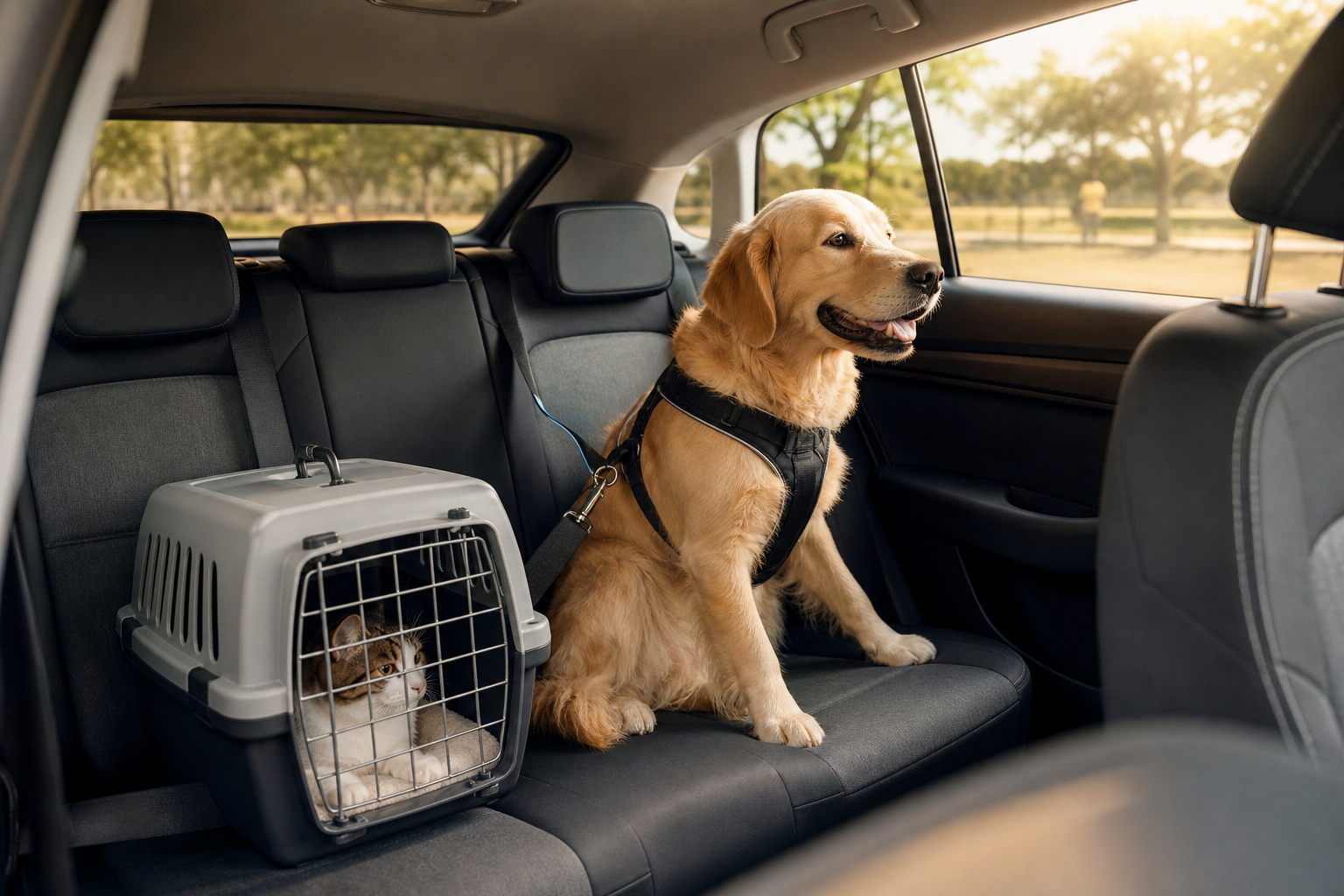
Dog seat belt on the rear seat
A dog seat belt is actually a system made up of a car harness, connector and anchorage point. It should not be confused with attaching a lead to a collar: in the event of sudden tension, the neck may be exposed to dangerous forces. ADAC also advises against using a collar as a safety system and identifies a harness as necessary when the dog is not travelling in a carrier. S1 (adac.de)
Advantages
- takes up little space;
- is suitable for dogs that do not tolerate a carrier;
- allows the dog to sit or lie on the rear seat;
- can be used with a seat protector.
What to check before buying
Choose a harness in the correct size, with secure adjustments and durable materials. The connector must be compatible with the vehicle and used exactly as specified by the manufacturer. It is better to avoid very long extensions or systems that allow the dog to move freely from one side of the passenger compartment to the other.
The words “crash tested” are not, by themselves, a sufficient guarantee. The Center for Pet Safety notes that many manufacturers claim to have conducted tests without publishing detailed evidence. It distinguishes products that have simply been tested from those certified under an independent programme. S3 (centerforpetsafety.org)
Carrier on the rear seat
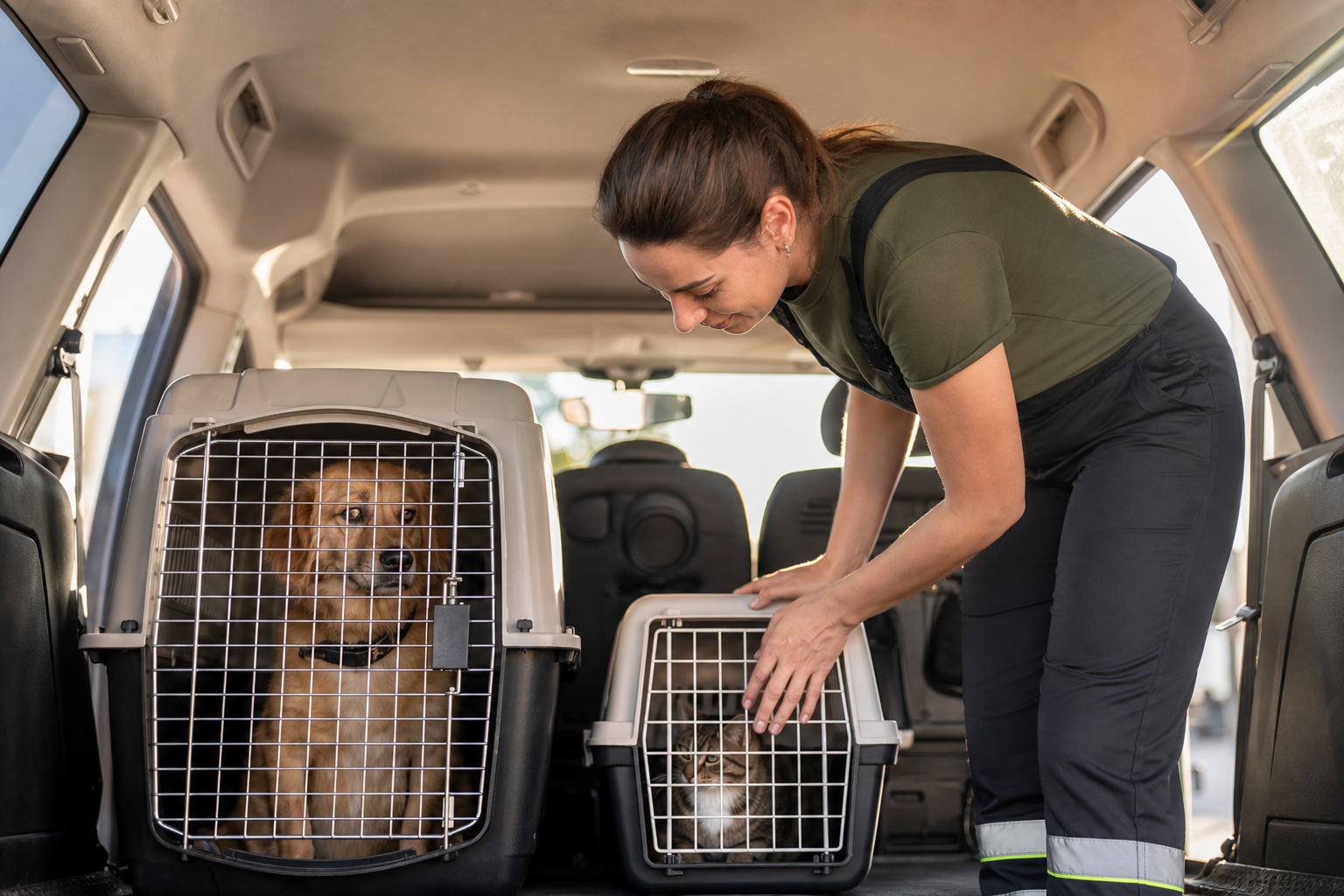
For small and medium-sized dogs, a rigid carrier or structured soft carrier can be a practical option, provided it is securely attached to the vehicle. A carrier placed on the seat but not anchored may move or overturn during braking. Even a model designed for use in a car should be selected according to the dog’s size and the manufacturer’s specified attachment method.
The dog should be able to adopt a natural position, with adequate ventilation and without overheating. General transport guidance highlights the importance of preventing escapes and falls, maintaining good ventilation and providing enough room for natural movement. S4 (salute.gov.it)
When to choose it instead of a harness
A carrier may often be more suitable for:
- small dogs;
- animals that become very agitated when they can see outside;
- journeys where the dog’s movement needs to be more restricted;
- puppies that are not yet accustomed to a seat belt or harness.
Before travelling, gradually get the dog used to the carrier, starting with short periods and a familiar environment. Do not force the dog to enter, and do not use the carrier only for stressful journeys.
Partition, barrier and luggage compartment
A net or grille partition can prevent the dog from reaching the front passengers, but it does not always adequately control sideways movement or protect the animal. For this reason, it is preferable to use it as additional protection, together with a carrier or another suitable restraint system. S1 (adac.de)
In the luggage compartment of an estate car, SUV or similar vehicle, a more complete option may be a rigid crate secured to the vehicle’s anchorage points. The crate should not be excessively large: it should allow the dog to stand, turn around and lie down, without giving the animal enough room to be thrown around inside it. The crate must also be anchored; simply placing it in the compartment is not sufficient. S1 (adac.de)
Quick comparison
| Option | Main strengths | Main limitations |
|---|---|---|
| Harness and seat belt | Space-saving and suitable for the rear seat | Highly dependent on quality, fit and anchorage |
| Secured carrier | Contains the dog and limits movement | Requires space and prior acclimatisation |
| Crate in the luggage compartment | Suitable for larger dogs and frequent journeys | Requires a compatible vehicle and correct attachment |
| Net or grille partition | Separates the passenger compartment from the rear area | Does not fully control the dog on its own |
| Blanket or hammock | Protects the seats and reduces accidental falls | Is not a true restraint without a seat belt or carrier |
The most practical choice for the rear seat
For a dog travelling on the rear seat, the most balanced option is generally a car-specific harness, correctly adjusted and connected to a short, stable system, or a carrier compatible with the seat and properly secured. The best solution depends on the dog’s size, behaviour, available space and ability to remain calm: no device is universally suitable for every dog.
Instead, avoid allowing the dog to travel loose, attaching the seat belt to a collar, using an unsecured carrier or choosing extensions that give the dog uncontrolled freedom of movement. Never leave the dog alone in the car during a journey: the interior temperature can become dangerous even when it does not seem particularly hot outside. S5 (politicalanimal.rspca.org.uk)
Pre-departure checklist
- Harness or carrier in the correct size.
- System secured to the vehicle, not merely placed inside it.
- No attachment to the collar.
- Unobstructed ventilation and no heavy objects near the dog.
- Gradual acclimatisation to the restraint or carrier.
- Breaks, water and comfort checks on longer journeys.
- Never leave the dog unattended in the car.
In short: a seat belt is a good option on the rear seat when used with a purpose-designed harness and a reliable anchorage; a carrier offers more containment, but only when it is the right size and correctly secured.
Sources
- [S1] Hund im Auto: Hundetransport-Systeme — ADAC
- [S2] Articolo 169 – Trasporto di persone, animali e oggetti sui veicoli a motore — Automobile Club d’Italia
- [S3] CPS Certified – Independent Pet Product Safety Certification — Center for Pet Safety
- [S4] Protezione e condizioni di trasporto degli animali — Ministero della Salute
- [S5] Transporting dogs in cars — RSPCA