Transporting Live Animals: How to Prepare for a Safe Journey
Transport guidesDocuments, carriers, route planning, breaks and stress management: a practical guide to organizing short or long journeys with companion animals safely and predictably.
In this guide
Transporting a live animal involves more than getting from one place to another. A safe journey requires planning for security, comfort, documentation, environmental conditions and the animal’s species-specific needs.
This guide is mainly intended for dogs, cats and small companion animals travelling by car, although some principles also apply to other forms of transport. Requirements may vary depending on the species, destination, vehicle, and whether the journey is private or commercial.
Important note: Transporting livestock, horses or animals for commercial purposes may be subject to specific requirements that differ from those described here. In the European Union, commercial transport and the transport of live animals are governed by dedicated rules covering animal welfare, fitness to travel, vehicles and journey planning. S1
Before setting off: define the type of journey
Preparation depends on the length and complexity of the trip.
Short journeys
For a short transfer, such as a visit to the vet, a boarding facility or a new home, the essentials are:
- a suitable carrier or restraint system;
- identification and up-to-date contact details;
- water available on arrival;
- a familiar blanket or other known item;
- a route with as few unexpected stops as possible.
Even a short journey can become stressful if the animal is loaded without preparation or left loose inside the vehicle.
Long journeys
Trips lasting several hours require more careful planning and time for breaks. Check suitable rest areas, animal-friendly accommodation, possible changes of transport and what to do in the event of delays.
Breaks are not only opportunities to let an animal out. They also allow you to check the carrier, offer water, manage toileting and ensure that the environment remains ventilated and comfortable. Practical guidance for travelling by car recommends regular stops, water and controlled movement, especially for dogs. [S2]S3
Documents and identification
For journeys within Italy, documentation depends on the species and circumstances. For dogs, cats and ferrets travelling within the European Union with their owner or an authorised person, identification, a valid rabies vaccination and a European pet passport are generally key requirements. The Italian Ministry of Health states that the Italian passport is issued by local health authority veterinary services; for dogs, it is linked to prior registration in the canine registry. S4
Before international travel, always check:
- the requirements of the destination country;
- the requirements of countries you will pass through;
- that the microchip is valid and matches the documents;
- vaccinations and any applicable waiting periods;
- the rules of the airline, railway, shipping company or other transport operator;
- any required health certificates, authorisations or treatments.
Entry into the EU from a non-EU country may require, among other things, a microchip, rabies vaccination, a health certificate and, in some cases, a rabies antibody test. Conditions depend on the country of origin and the rules in force on the travel date. S5
Travel folder
Keep the following in a folder, preferably in digital form as well:
- the animal’s passport or certificates;
- microchip number;
- owner’s contact details;
- contact details for the usual vet;
- bookings and confirmations from the carrier;
- destination address;
- any health information already provided by the vet.
Do not wait until the day of departure to check the documents. Some requirements involve specific time frames and cannot be completed at the last minute.
Choosing and preparing a carrier
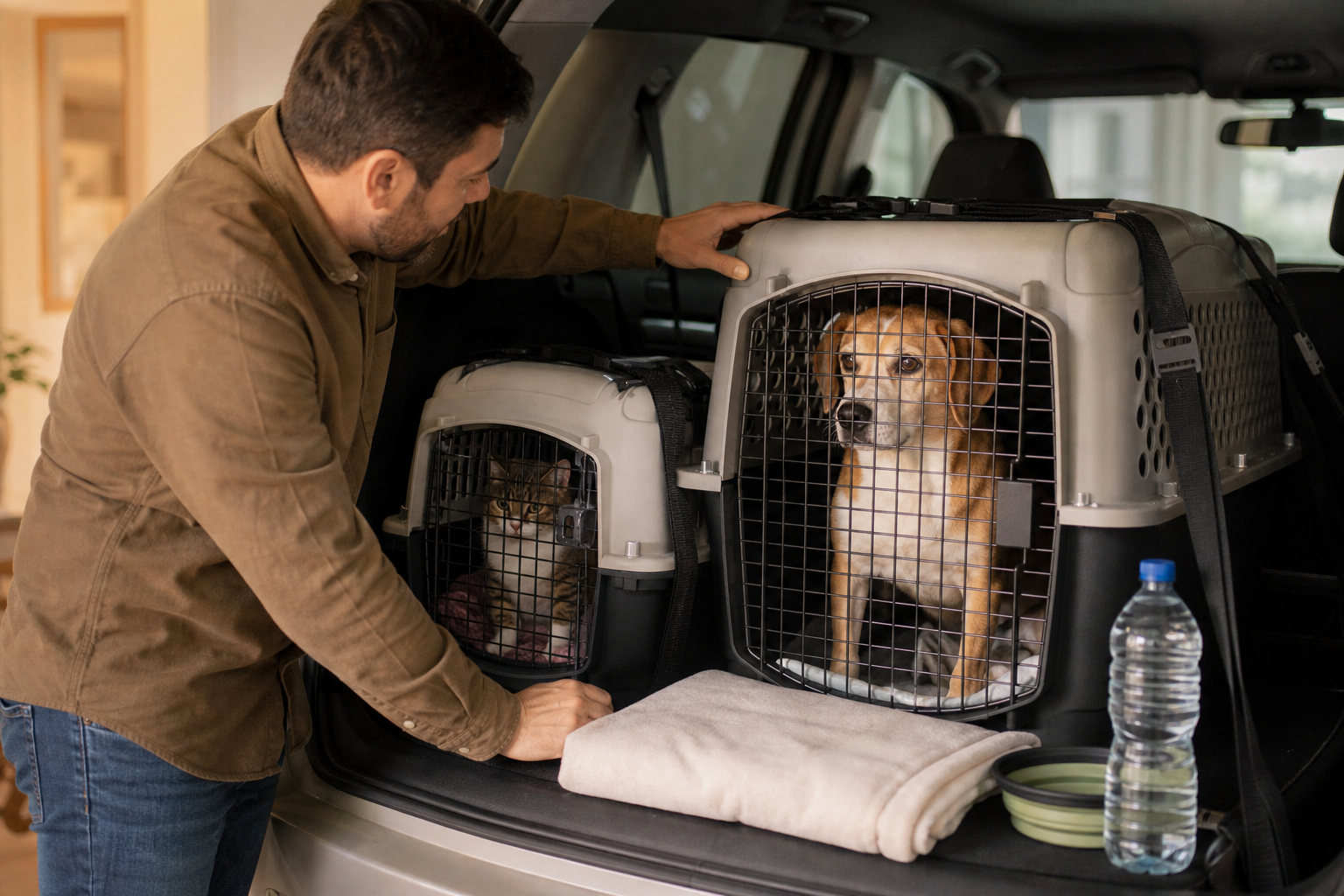
The carrier should be sturdy, well ventilated, undamaged and appropriate for the animal’s size. In general, the animal should be able to adopt a natural position, turn around and settle without being compressed. At the same time, excessive space can allow dangerous movement during braking or cornering.
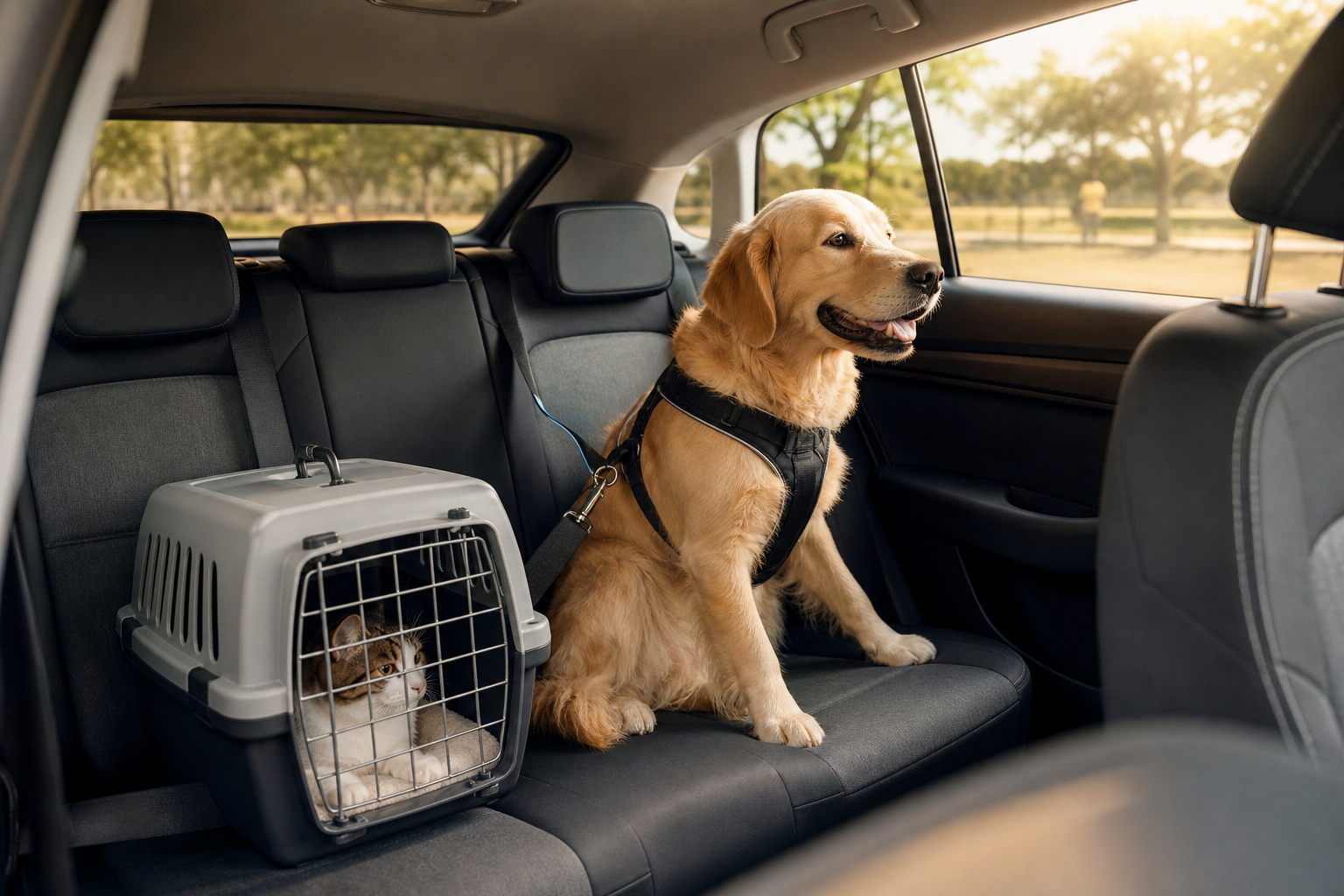
For larger dogs, a vehicle-specific restraint system or a harness approved for attachment to a seat belt may be preferable, provided the manufacturer’s instructions are followed. A dog loose inside the vehicle can distract the driver, be injured or escape accidentally during a stop. [S2]S6
For cats, rabbits and small animals, a secure enclosed container is generally important. Never use an improvised box or a container with openings through which the animal could escape.
Getting the animal used to the carrier
If possible, leave the carrier open at home for several days before the journey. Place a familiar blanket inside and allow the animal to explore it without forcing the animal in. Short, gradual practice sessions can help make the carrier and car feel less unfamiliar. S6
Do not give sedatives or calming medication on your own initiative. If you are concerned that the journey may be difficult, ask a professional for guidance well in advance so that suitable options can be considered without improvising on the day.
Safety during car travel
While the vehicle is moving:
- secure the carrier so it cannot slide or tip over;
- do not place the animal in the front seat when an active airbag is present;
- do not allow the animal to put its head out of the window;
- do not let the animal travel loose between the seats or in the footwell;
- maintain a reasonable temperature and adequate airflow;
- keep water, a lead and absorbent material within reach.
Never leave an animal alone in a parked car, especially in hot weather. Even a seemingly short stop can quickly turn the passenger compartment into a dangerous environment. [S2]S3
Planning the route and breaks
The best route is not necessarily the fastest one on paper. Consider:
- The actual duration: include traffic, refuelling and stops.
- Rest areas: choose places away from heavy traffic where the animal can be handled safely on a lead.
- The weather: avoid the hottest hours and difficult weather conditions whenever possible.
- Safe opening procedures: before opening a door or boot, make sure the animal is already on a lead or secured in the carrier.
- A backup plan: identify a place to stop in case of delays, breakdowns or route changes.
There is no single break interval suitable for every animal and every journey. Break frequency should take into account the species, age, habits, temperature and total travel time. For dogs, practical guidance for road travel suggests frequent stops for drinking, movement and toileting. For cats and small animals, it is often safer to manage breaks without letting them loose in open areas. [S2]S3
Food and water
Avoid changing the animal’s usual diet on the day of departure. Bring its normal food and an additional supply in case of delays.
On long journeys, arrange access to water in a way that is compatible with the carrier and vehicle safety. A spill-resistant bowl or container designed for transport may reduce leaks and dampness, but test it before departure.
There is no identical feeding rule for every species. It is sensible to avoid large meals immediately before departure and to plan any meals during breaks without introducing new foods. For specific needs or animals with particular health conditions, ask your vet for guidance.
Managing stress and unexpected problems
Noise, movement, unfamiliar smells and changes to routine can increase stress. To reduce stimulation:
- use a familiar blanket;
- speak calmly;
- avoid loud music and unnecessary handling;
- do not open the carrier in unprotected areas;
- allow extra time for loading, stops and arrival.
If the animal appears unusually lethargic, injured or in difficulty, stop the journey when it is safe to do so and contact a professional. This guide does not replace a veterinary assessment.
Departure checklist
Documents
- Microchip or other identification checked
- Passport, certificates and vaccinations checked
- Destination requirements confirmed
- Carrier’s rules confirmed
- Useful contact details saved offline as well
Equipment
- Suitable carrier or restraint system
- Vehicle fastening system
- Lead, harness and identification tag
- Water and bowl
- Usual food and an additional supply
- Familiar blanket
- Training pads, litter or absorbent material
- Waste bags and cleaning supplies
- Recent photograph of the animal
Route
- Realistic itinerary and timings
- Rest areas identified
- Breaks planned
- Backup plan for delays
- Weather conditions checked
In summary
Safe animal transport is built on three elements: correct restraint, realistic route planning and preparation in advance. On short journeys, the priorities are preventing escapes and driver distraction. On long journeys, breaks, water, ventilation and contingency planning become particularly important.
Documentation requirements are not the same for every destination or species. It is therefore essential to check official sources and, when necessary, confirm the requirements with the relevant veterinary service, carrier or authorities in the destination country. Good planning cannot eliminate every difficulty, but it reduces surprises and helps you manage the journey with greater control.
Sources
- [S1] Animal welfare during transport — Commissione europea
- [S2] Road trip safety tips — VCA Animal Hospitals
- [S3] Taking Your Pet on Holiday — RSPCA
- [S4] Passaporto per animali da compagnia — Ministero della Salute
- [S5] EU rules on travelling with pets and other animals in the EU — Your Europe / Unione europea
- [S6] Dog Behavior and Training: Traveling — Air and Car Travel — VCA Animal Hospitals